
Great art often enters our lives through unexpected portals. For me, the journey into the world of Tamara de Lempicka began not in a museum wing, but on a film screen, framed within the sharp shadows and dark Art Déco aesthetics of a Batman feature. In that cinematic setting, her canvases immediately stood out: bold, sculptural, hyper-modern figures that demanded absolute attention.
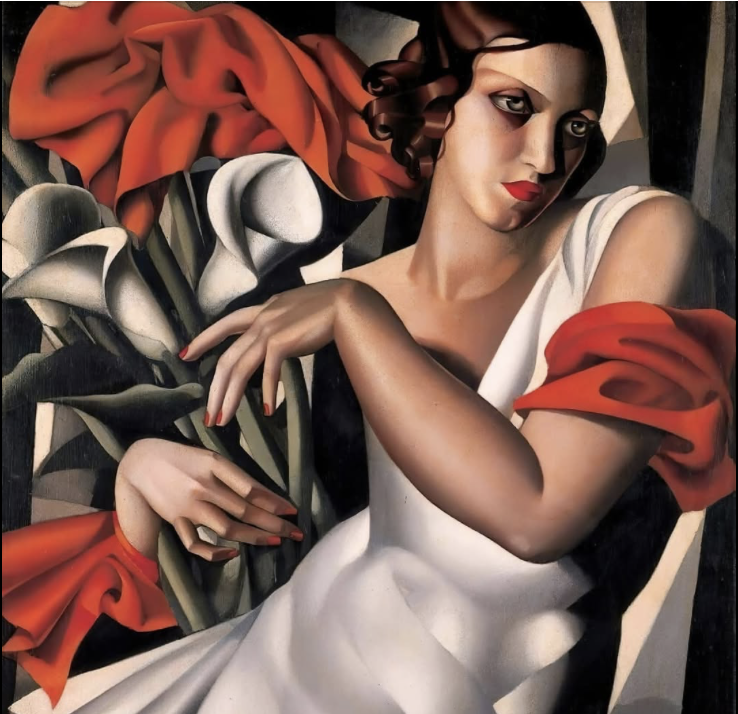
That initial spark led to a lasting fascination, driving me to visit multiple exhibitions over the years to experience the tactile, metallic power of her original works up close.
“Lempicka did not merely paint the Roaring Twenties;
she forged their physical architecture out of steel, silk, and unyielding self-determination.”
1. The Art Déco Machine Age: Cubism Meets Elegance
Born in Poland and refined in the high-society salons of Paris and Hollywood, Tamara de Lempicka synthesized two opposing forces of the early 20th century: the analytical geometry of Cubism and the polished sensuality of Renaissance portraiture.
Her figures appear chiselled from marble or burnished steel. The folds of their dresses mimic industrial sheet metal; their skin radiates a cold, pristine luster. In Lempicka’s hands, modern machinery—aeroplanes, luxury automobiles, skyscrapers—was not just a backdrop, but an extension of the human posture.
Standing in front of her canvases at an exhibition, one feels the weight of a world moving at high speed, captured with surgical precision.
2. Uncompromising Authority and Independence
If Jack Vettriano paints the quiet, suspended moments of shared romance, Lempicka paints the unapologetic assertion of individual power.
In Portrait of Ira P., the posture is masterfully ambiguous. The downward glance, the subtle tilt of the head, and the sculpted drape of silver fabric do not project vulnerability; they project absolute self-containment. The subject does not seek approval from the viewer, but rather commands the space around her.
Look closely at her portraits and you will find an obsession with control:
- The Sharp Lines: Zero softness, zero ambiguity; every plane is carved with intent.
- The Gaze: Her subjects rarely smile or seek approval. They observe the world with aloof confidence.
- The Drape of Fabric: Heavy silks and satins that fold like architectural structures rather than loose cloth.
3. From Gotham Shadows to Modern Leadership
It is no coincidence that directors and production designers frequently place Lempicka’s works inside the homes of fictional titans and dark, urban narratives. Her art speaks the language of ambition, speed, and structural integrity.
In leadership and strategy, Lempicka’s oeuvre offers a compelling lesson in clarity of form. She reminds us that softness is not always required to achieve grace, and that true presence comes from defining your parameters with absolute firmness.
Living with Lempicka’s Vision
To appreciate Tamara de Lempicka is to embrace a philosophy of bold execution. It is the drive to master one’s environment, to refine every detail of execution until it carries the weight of a sculpture, and to navigate complex landscapes with the steady hands of someone driving a Bugatti at full speed.
This article is part of Narratives on Canvas, an editorial series on antoniounfolded.it examining the geometry of presence and atmosphere through modern masters. Discover the previous chapter on Jack Vettriano: The Elegance of Suspended Time, read the next piece on Edward Hopper: The Geometry of Silence, or explore the complete comparative essay.