
There is a precise moment in a room—or on a wind-swept beach at twilight—when conversation stops, and atmosphere takes over. It is the territory where Jack Vettriano built his visual signature: an unashamedly narrative world defined by cinematic elegance, composed sensuality, and the quiet ritual of human connection.
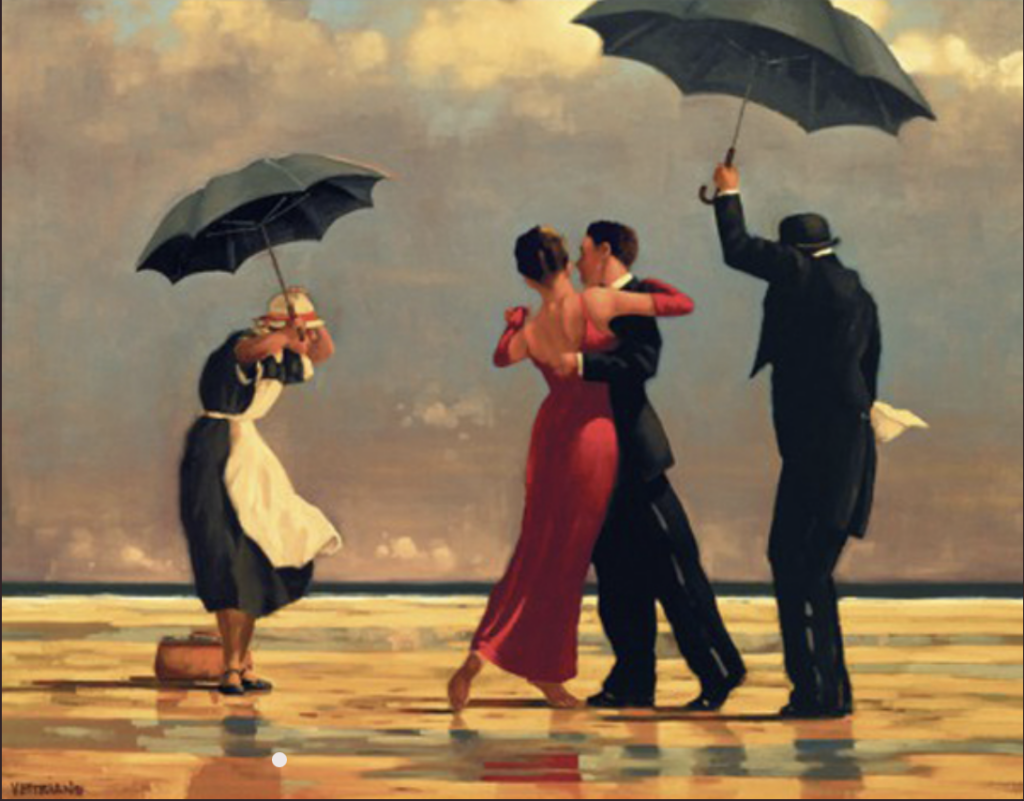
A Chance Encounter in London
My personal connection to Vettriano’s work began years ago at an exhibition in Glasgow. Standing in front of The Singing Butler—a canvas that has always held a special place in my imagination—I found myself drawn into a spontaneous, unfiltered conversation with a gentleman standing next to me.
We exchanged thoughts on the light, the wind-swept posture of the dancers, and the quiet dignity of the butler holding an umbrella against the gale. There was no academic pretense, just an honest exchange of impressions between two observers.
It was only as we prepared to part ways that he extended his hand with a quiet smile:
“Pleasure to have met you, Antonio. I hope to see you again. Jack.”
To discuss a masterpiece alongside the man who brought it to life, before knowing who he was, remains one of those rare moments where art and reality align without ceremony.
1. The Cinematic Frame: Narrative without Words
In an era dominated by abstract concepts and cold minimalism, Vettriano’s work stands out for its bold commitment to figurative storytelling. His canvases do not ask for complex academic decoding; they evoke an immediate sensory memory.
A black-tie couple dancing on wet sand under dark umbrellas; a lone woman leaning over a hotel balcony at dusk; a silent gaze shared across a polished mahogany bar over a glass of Islay whisky or a classic cocktail. Vettriano paints the scenes we construct in our minds when we seek timeless sophistication.
His figures are caught in motion or in suspended anticipation. The viewer is never a passive observer, but an uninvited witness to a private chapter.
2. The Rituals of Elegance
Look closely at a Vettriano canvas and you will find an obsession with formal detail:
- The Tailoring: Tuxedos, sharp lapels, silk gowns, and raincoats worn with nonchalant grace.
- The Setting: Dimly lit lounge bars, grand hotel suites, stormy coastlines, and shaded verandas.
- The Gestures: The deliberate pour of a drink, the strike of a match, the tilt of a fedora.
For Vettriano, elegance is not mere ostentation; it is a discipline of posture and respect for the moment. It reminds us that rituals—how we dress, how we hold a glass, how we pause before speaking—carry an intrinsic aesthetic weight that modern haste often erodes.
3. The Tension Between Shadow and Light
Critics have often debated Vettriano’s place in the traditional art canon, yet his work resonates precisely because it taps into universal longings: romance without sentimentality, mystery without chaos, and solitude shared in good company.
His lighting is fundamentally theatrical. Strong contrasts, deep shadows, and warm pools of light highlight the contours of his subjects while leaving the background shrouded in ambiguity. All that matters is the absolute composure of the present frame.
The Vettriano Ethos in Modern Life
Living with an appreciation for Jack Vettriano means reclaiming the art of slow elegance. It is the conscious choice to create spaces for quiet atmosphere—whether over a late-night drink, an unhurried conversation, or a moment of reflection before the day demands your full speed.
Vettriano teaches us that style is not about complexity; it is about the quiet confidence of standing still while the world rushes past.
This article is part of Narratives on Canvas, an editorial series on antoniounfolded.it exploring how figurative art, atmosphere, and human posture intersect with modern leadership. Continue reading the series with Tamara de Lempicka: The Architecture of Desire and Power or with Edward Hopper: The Geometry of Silence and Unscripted Connections.
Pingback: Tamara de Lempicka: The Architecture of Desire and Power