
Some encounters feel as though they were painted before they actually took place.
I was in Chicago, sitting at a classic American diner counter over morning coffee—the kind of setting where strangers sit side-by-side separated only by inches of Formica and quiet routine. A conversation naturally opened with the woman sitting next to me, a sharp New York businesswoman. By the end of breakfast, she invited me to join her late that afternoon for an Edward Hopper exhibition at the museum.
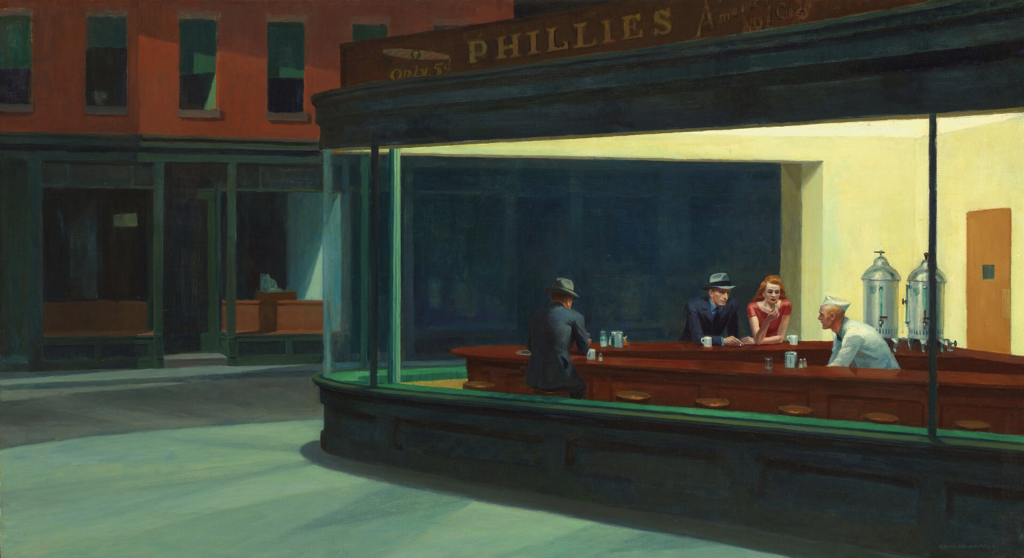
That chance encounter at a diner counter did not merely lead to a memorable afternoon in front of Hopper’s masterpieces; it turned into a lasting professional relationship that eventually brought me to deliver lectures at New York University (NYU).
Looking back, the entire sequence felt like a living scene from Hopper’s own world: an unscripted bridge built in the quiet spaces of an American city.
“Hopper does not paint isolation; he paints the fertile quiet from which clarity,
observation, and unexpected human connection emerge.”
1. The Architecture of the Counter: Nighthawks and Urban Intimacy
Sitting at a diner counter in Chicago carries a distinct spatial energy. It is an urban design built for proximity without intrusion—a place where independent paths briefly intersect.
Hopper understood this architecture better than anyone. In Nighthawks (1942), his most famous canvas, the brightly lit diner stands as a sanctuary of warm yellow light against the dark, quiet street outside. The figures sitting at the counter are wrapped in their own thoughts, yet they share the same physical refuge.
Hopper’s diners, hotel lobbies, and office spaces are never empty; they are filled with attentive silence. They remind us that being alone in a city is not loneliness—it is a moment of observation, a pause where the mind processes the noise of the day and opens up to spontaneous dialogue.
2. Light, Geometry, and Strategic Clarity
Where Tamara de Lempicka uses sharp industrial lines to project power, and Jack Vettriano uses theatrical shadows to evoke romance, Edward Hopper uses sunlight and geometry to carve out mental space.
Look closely at his architectural compositions:
- The Windows: Large panes of glass acting as transparent boundaries between internal reflection and external reality.
- The Sunlight: Long, diagonal blocks of late-afternoon light cutting across empty rooms, highlighting posture and focus.
- The Composition: Clean, uncluttered planes that remove unnecessary distractions to reveal the essence of the scene.
For leaders and executives, Hopper’s geometry offers a powerful metaphor for cognitive space. In a business culture dominated by constant notifications and reactive meetings, Hopper reminds us of the value of quiet observation—the ability to sit back, look out the window, and analyze the broader landscape before making a decision.
3. From Chicago to NYU: The Value of Openness
The fact that a morning conversation at a Chicago counter led directly to an academic podium at NYU is a testament to what happens when we remain present in our surroundings.
Hopper’s paintings capture the quiet crossroads of modern life—the train cars, the hotel rooms, the diner seats where professionals pause between destinations. When we approach those spaces with genuine curiosity rather than digital distraction, extraordinary opportunities emerge.
“Technical competence prepares you for the lecture hall; but human presence at a diner counter is what opens the door.”
The Hopper Ethos in Executive Life
Living with an appreciation for Edward Hopper means respecting the power of the pause. It is the understanding that solitude is not a vacuum to be filled, but a strategic asset—a quiet space where observations settle, perspectives sharpen, and life’s most unexpected chapters begin.
This article is part of Narratives on canvas, an editorial series on antoniounfolded.it analyzing art, urban solitude, and strategic clarity. Revisit the chapters on Jack Vettriano and Tamara de Lempicka.
Pingback: Narratives on Canvas: Art, Atmosphere & Modern Solitude
Pingback: Tamara de Lempicka: The Architecture of Desire and Power