
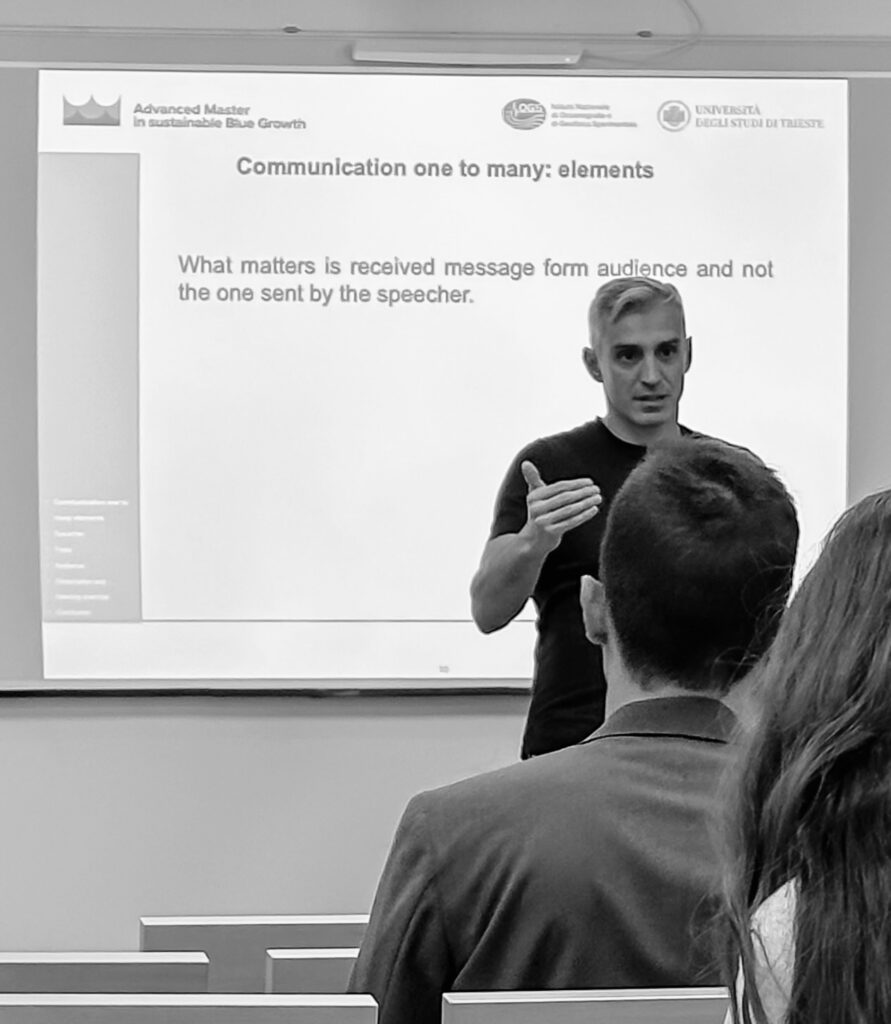
There are environments where the density of technical talent and empirical evidence is almost tangible. I experienced this recently in Trieste during a masterclass for the Advanced Master in Sustainable Blue Economy, co-organized by OGS(National Institute of Oceanography and Applied Geophysics) and the University of Trieste.
In the room was an international mosaic of extraordinary profiles: PhDs in marine biology, environmental engineers, aquaculture pioneers, and international relations specialists. Minds capable of decoding oceanic health and measuring complex ecosystem dynamics.
Yet, behind the rigor of their data lies a subtle, pervasive frustration—one shared by specialists, researchers, and technical executives across both public and private sectors. It is the realization that scientific truth or project excellence guarantees neither understanding, funding, nor policy adoption.
The gap between producing knowledge and driving real-world implementation is not a problem of content. It is a failure of strategic translation.
“In academia and research, you are defined by what you know.
In leadership and execution, you are defined by what you enable others to understand.”
The Trap of Specialization: The Curse of Knowledge

The spark for this reflection came directly from a post-lecture exchange on LinkedIn with Douniazed Abbani, an aquaculture specialist and participant in the Master. She highlighted a reality that many technical experts face: the challenge of making complex, data-heavy work resonant and actionable for non-specialist audiences.
In behavioral psychology, this challenge is formalized as The Curse of Knowledge. The principle is dangerously simple: the more expert an individual becomes in a specific domain, the more their brain loses the ability to reconstruct what it felt like not to possess that knowledge.
When an hyper-specialized researcher or technical leader presents an initiative to a decision-maker—whether a government minister, an investment committee, or a Corporate Board—their instinct is to saturate the delivery with methodological detail, acronyms, and exhaustive caveats. In their mind, they are demonstrating competence. In the listener’s mind, they are generating Cognitive Noise.
Faced with cognitive overload, a decision-maker’s brain does not process; it defends itself. It disengages, postpones, or rejects the proposal entirely.
“Good communication is not about saying more, but about making your main point easier to understand.”
— An insight emerged during the SBE Masterclass discussion.
Less Noise, More Signal: The Scientific Translation Matrix
Overcoming the Curse of Knowledge requires an act of cognitive empathy: shifting focus from what you know to what the counterpart needs to decide.
No investor, board member, or policymaker approves a transformation plan based on technical architecture alone. Decisions happen at the intersection of evidence and systemic clarity.
During the masterclass, we worked on a Scientific Translation Matrix designed to convert raw evidence into an actionable framework:
- The Raw Data: “A 34% reduction in coastal biomass has been recorded.” (Relevant to peer researchers, opaque to decision-makers).
- The Systemic Impact: “High risk of economic collapse for the local fishing industry within three years.” (Captures immediate attention and establishes urgency).
- The Executive Call to Action: “Approval of the coastal protection framework by Q4 to safeguard regional employment.” (Provides a clear, signable decision).
Effective communication is never about dumbing down content. It is about removing friction so that technical truth can drive action.
Executive Presence: Balancing Competence and Warmth
There is a second hurdle in translating expertise into impact: the myth of cold neutrality. Social psychology demonstrates that human beings evaluate leaders through two primary lenses: Competence and Warmth/Trustworthiness.
Highly specialized professionals often over-index on competence. The result is an authoritative yet distant, academic demeanor. Conversely, relying solely on warmth without rigorous data backing risks appearing superficial.
True Executive Presence emerges from balancing both:
- Analytical Rigor (Logos): Precision of language and the elimination of ambiguity.
- Commanding Presence (Ethos & Pathos): Posture control, inclusive eye contact, and the deliberate use of the Strategic Pause. A conscious silence between key points does not signal hesitation; it projects control, authority, and respect for the listener’s cognitive load.
From Performance to Leadership
A keynote, a research report, or a high-stakes pitch is not an exercise in public speaking performance. It is an act of bridge-building.
In complex, high-impact sectors like the Sustainable Blue Economy, energy transition, or digital transformation, we desperately need domain experts who can step out of the ivory tower of technical language.
Technical brilliance gets you a seat at the table. But strategic communication, emotional intelligence, and narrative control determine whether your ideas will actually change the world.